The short answer
Who you should hire depends on three things: how big the team is that actually uses HubSpot, how fast you need it, and how much is riding on it. Not on your total headcount. A 200-person company with two salespeople has a small HubSpot setup. A sales team of ten or more needs a different system, and more senior help.
| Your situation | Hire | What to check |
|---|---|---|
| Small HubSpot team (about 2 sellers), you need the basics | A freelancer or a general marketing agency | They've set up your hub before |
| HubSpot-specific problems, you want it done fast and right | A HubSpot-focused partner | They do HubSpot and nothing else |
| 10+ in sales, integrations, or HubSpot is your bottleneck | A senior HubSpot specialist team | Who works in your portal, references at your scale, documentation and backup |
| You have an in-house RevOps team | In-house, plus a specialist for the one or two hard things | They work with your team, not around it |
What a HubSpot consultant actually does
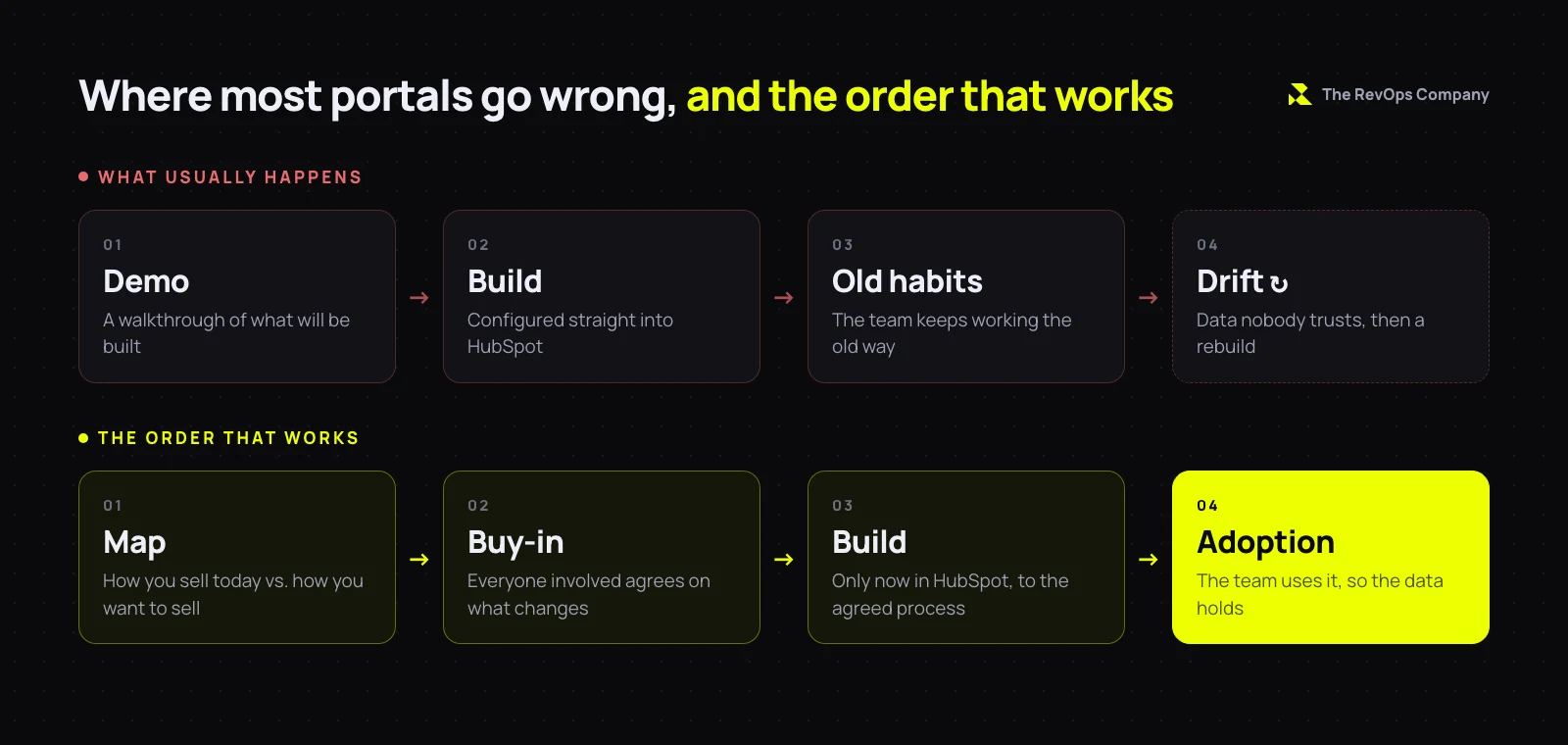
The job isn't clicking settings. It's three things, in this order:
- Map how you sell today and how you want to sell, and make clear what changes.
- Get everyone who touches the process to agree on that picture.
- Build it in HubSpot.
Most consultants start at step 3. That's where almost every portal we take over went wrong, more on that below.
Freelancer, agency, partner or in-house
Freelancer. Great for basics and quick help when your HubSpot team is small. A freelancer becomes the wrong choice when HubSpot is a bottleneck or a core part of how you make money. Then you don't want everything to depend on one person. The risk isn't the size of who you hire. It's one person, no documentation and no backup.
General marketing agency. Fine for the basics, especially if they already run your marketing. For HubSpot-specific questions, a HubSpot-focused agency will be faster and get it right more often.
HubSpot partner. Partners come in very different shapes, from large agencies to small senior teams. That difference matters more than the tier on their badge, see the next section.
In-house. Hiring your own RevOps person makes sense at some point, depending on your size, speed, tech stack and company strategy. But hiring in-house doesn't mean you should stop working with outside specialists. The big teams I work with have their own RevOps people and still bring in specialists for one or two things. The in-house team owns the decisions. The outside team brings context and experience from other clients, so the in-house team can focus on everything else. I'm biased here, obviously.
Big agency or senior team: size isn't the signal
Smaller, senior teams are usually more flexible and more invested in your account, and you're more likely to work with the people you actually chose. Bigger agencies run on fixed ways of working: set communication channels, playbooks, a standard way of building. Some buyers want exactly that predictability. Others find it slow. That one comes down to how you like to work.
What size doesn't tell you is quality. At bigger agencies the senior person often sells the project and juniors build it. So don't ask how big they are. Ask who will be in your portal, how fast they reply, and who they've done this for at your scale.
For what it's worth, enterprise teams hire specialist teams too. At Signify we ran in-office training and worked on strategy, integrations and adoption. Kevin Raaijmakers, their Sales Director EU & US: "Kevin works fast, clear and digital." Dennis Monner, CEO of Open Systems: "We strongly recommend Kevin. He is working fast, super effective and knows to fix all problems… like a bit magic ;)"
What it costs
It depends on how you buy (a project, an ongoing team, or hourly help), who you hire, and where they're based.
Most buyers still compare on hourly rates, so here's roughly what senior, HubSpot-specific help costs:
| Where | Typical senior rate |
|---|---|
| US | $200+ per hour |
| Europe | €125+ per hour |
| India, Pakistan, the Philippines | €30+ per hour |
These are estimates from what I see in the market, not a price list.
I don't think hourly makes much sense anymore. With AI and years of portals behind you, good work gets faster every year. Hourly billing rewards the opposite: the slower someone works, the more you pay. A fixed price puts the risk of overruns on the consultant, not on you.
That's why we only work two ways: a Sprint, a fixed scope at a fixed price from US$9,700, or a Marathon, a senior team in your portal every month from US$4,000 a month.
What goes wrong: what we find when we take over a portal
Almost every portal we take over, whether from a freelancer, a general marketing agency or another partner, has the same problem. Nobody mapped the process. It's unclear how the team works today, how they want to work, and what would change. And it's unclear whether everyone involved actually agrees. There's no real buy-in.
Without it, someone makes changes, the rest of the team doesn't follow the new process, and the portal drifts. That's not a HubSpot problem. It's an alignment problem, and it shows up in HubSpot.
Before us, Open Systems worked with a large, well-known Elite HubSpot agency. They paid premium prices but didn't get premium service: juniors on the account, slow replies, and changes that were rarely right the first time, so everything took several rounds. Their team expected fast iterations and clear communication. On top of that, what was being built didn't match what the team wanted. An alignment problem, not a skills problem.
Questions to ask on the first call
- Who will actually work in our portal? Not who's on this call. Ask to meet them.
- How do you map our current and future process before you build? If the answer is a demo of what they'll build, that's step 3 first.
- How do you get the rest of our team on board? Getting buy-in is part of the job, not something you sort out afterwards.
- How fast do you reply, and how often do changes need a second round? Ask a reference, not the consultant.
Red flags:
- A senior sells the project, then you never hear from them again.
- A fixed plan or price before anyone has looked at your portal or your process.
- Premium prices with slow replies.
- Building starts before your team agrees on what's being built.
When you don't need a consultant
If your HubSpot team is small, you're on the basics and nothing is breaking, you probably don't need outside help yet. Start with the setup HubSpot gives you, keep it simple, and write down how your team should use it. Bring someone in when HubSpot starts slowing you down, not before.